News, News from the SEEHN Member States
The South-eastern Europe Health Network (SEEHN) joins the global efforts in managing changes of their health systems performance to end tuberculosis, particularly in the South Eastern European countries.
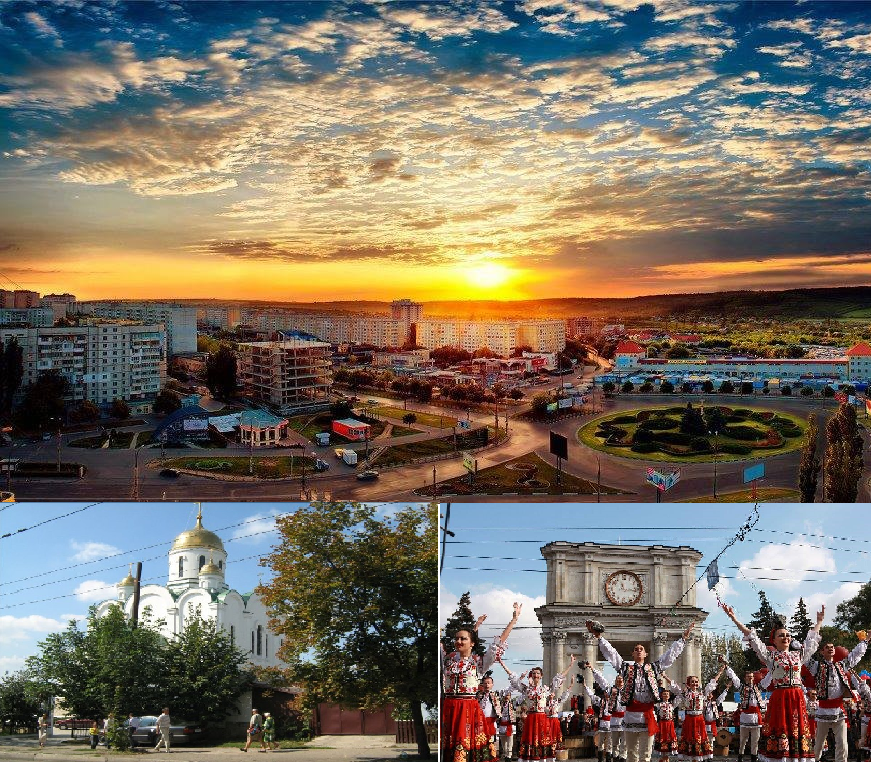
In the context of the World TB Day, celebrated on 24 March 2017, the SEEHN will have a meeting organized by WHO Regional Office for Europe on “Managing Change in Health System Related to Key Communicable Diseases”. This pre-Forum event will be held on 2 April 2017 in Chisinau, Republic of Moldova prior to the Fourth SEE Health Ministerial Forum “Health, well-being and prosperity in South-eastern Europe by 2030 in the context of the 2030 Agenda for Sustainable Development”.
The event has the aim to stress the importance TB control and its decrease in the region. It is an excellent opportunity to discuss with the key stakeholders of the SEE countries the present approaches and strategies on how to improve the communicable disease response through health system strengthening. Health services financing, new model of services delivery and new approaches to strategic planning of the human resources are among critical elements of the systems that may be reformed. Sustainability and self-reliance are the key focuses in the coming years.
The scope and purpose and programme of this very important event.
The WHO Europe TB profiles are specific for each country. They vary throughout the SEE countries. Detailed information might be downloaded following the links:
Albania:
https://extranet.who.int/sree/Reports?op=Replet&name=%2FWHO_HQ_Reports%2FG2%2FPROD%2FEXT%2FTBCountryProfile&ISO2=AL&LAN=EN&outtype=html
Bosnia and Herzegovina:
https://extranet.who.int/sree/Reports?op=Replet&name=%2FWHO_HQ_Reports%2FG2%2FPROD%2FEXT%2FTBCountryProfile&ISO2=BA&LAN=EN&outtype=html
Bulgaria:
https://extranet.who.int/sree/Reports?op=Replet&name=%2FWHO_HQ_Reports%2FG2%2FPROD%2FEXT%2FTBCountryProfile&ISO2=BG&LAN=EN&outtype=html
Croatia:
https://extranet.who.int/sree/Reports?op=Replet&name=%2FWHO_HQ_Reports%2FG2%2FPROD%2FEXT%2FTBCountryProfile&ISO2=HR&LAN=EN&outtype=html
Israel:
https://extranet.who.int/sree/Reports?op=Replet&name=%2FWHO_HQ_Reports%2FG2%2FPROD%2FEXT%2FTBCountryProfile&ISO2=IL&LAN=EN&outtype=html
FYROM:
https://extranet.who.int/sree/Reports?op=Replet&name=%2FWHO_HQ_Reports%2FG2%2FPROD%2FEXT%2FTBCountryProfile&ISO2=MK&LAN=EN&outtype=html
Republic of Moldova:
https://extranet.who.int/sree/Reports?op=Replet&name=%2FWHO_HQ_Reports%2FG2%2FPROD%2FEXT%2FTBCountryProfile&ISO2=MD&LAN=EN&outtype=html
Montenegro:
https://extranet.who.int/sree/Reports?op=Replet&name=%2FWHO_HQ_Reports%2FG2%2FPROD%2FEXT%2FTBCountryProfile&ISO2=ME&LAN=EN&outtype=html
Romania:
https://extranet.who.int/sree/Reports?op=Replet&name=%2FWHO_HQ_Reports%2FG2%2FPROD%2FEXT%2FTBCountryProfile&ISO2=RO&LAN=EN&outtype=html
Serbia:
https://extranet.who.int/sree/Reports?op=Replet&name=%2FWHO_HQ_Reports%2FG2%2FPROD%2FEXT%2FTBCountryProfile&ISO2=RS&LAN=EN&outtype=html
News, News from the SEEHN Member States
On 03 and 04 April 2017 the ministers of the nine countries members of the SEE Health Network will gather at their Fourth SEE Health Ministerial Forum in Chisinau, the Republic of Moldova. The Forum is co-organized by H.E: Ms. Ruxanda Glavan, President of the SEEHN, Minister of Health, Republic of Moldova and Dr. Zsuzsanna Jakab, Regional Director, WHO Regional Office for Europe. (more…)
News
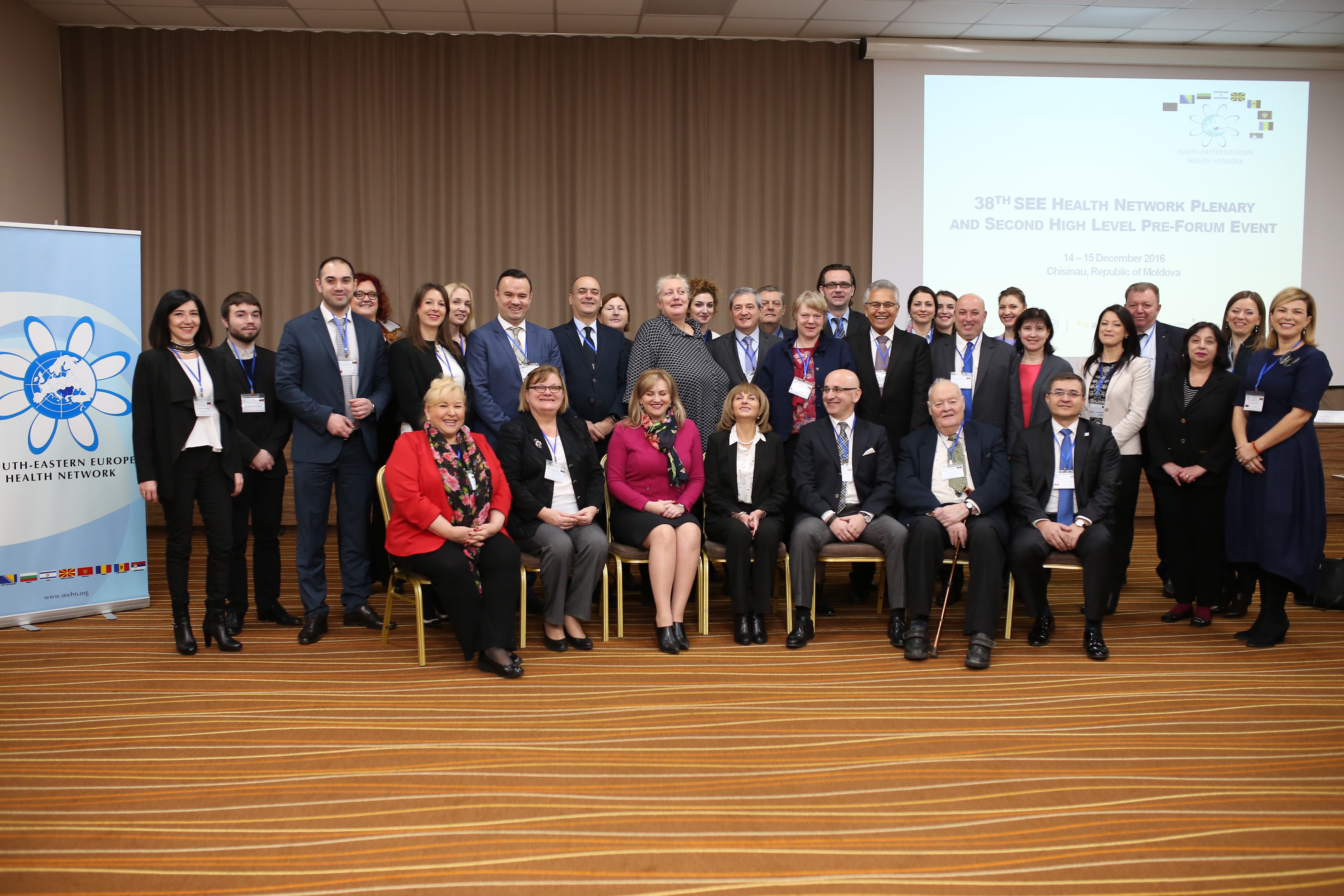
The 38th Plenary Meeting of the South-eastern Europe Health Network (SEEHN) was held on 14-15 December 2016 in Chisinau as the second High Level Pre-Forum Meeting with SEE National Health Coordinators, the Directors of the SEE Regional Health Development Centres and partners, organized jointly by the Presidency of the Republic of Moldova and the SEEHN Secretariat.
n
The 38th Plenary reviewed the level of preparation for the forthcoming Fourth SEE Health Ministerial Forum to be held on 03-04 April 2017 in Chisinau, discussed possible challenges facing the Forum and took important decisions, in particular related to the approval and signing of the Forum´s outcome documents: the Chisinau Pledge; the Framework for the development of the SEE Health Strategy 2030 in line with the UN SDGs 2030; the Memorandum of Understanding on the SEEHN on its STATUTES of 2016, and the Standard Operational Procedures of the SEE Health Network.
n
The meeting also provided an opportunity to discuss the Member States’ political commitment to the SEE regional collaboration, the needs for reforms in the light of the European Framework Health 2020 and the UN SDGs 2030 and further extend of the collaboration by identifying common targets for the SEEHN progress.
n
38 SEEHN PLENARY REPORTnAnnex 1 Presentations at the PenarynAnnex 2 List of technical documents discussed at the 38 PlenarynAnnex 3 Programme – 38 PlenarynAnnex 4 List of Participants – 38 Plenary
n
News
The European Public Health Association (EUPHA) Newsletter, First Edition, 2017, was just posted and is available on the following link: https://ephconference.eu/repository/publications/Newsletter_January_2017.pdf
n
The First Edition´s highlight is the new long-term Cooperation Agreement concluded and approved recently between the EUPHA and the European Centre for Disease Prevention and Control (ECDC).
n
This Newsletter’s First Edition is, also, a resource for important recent updates in research developments in areas such as non-communicable diseases (NCDs), health inequalities, etc. It presents shortly a brief overview of the European Journal of Public Health content and the newly launched website for easy access.
n
The newsletter has gathered and presented an excellent snapshot of the upcoming courses and conferences related to public health in 2017. Particular space is dedicated to the 10th European Public Health Conference: ‘Sustaining resilient and healthy communities’ to be held in the period of 1 – 4 November 2017 in Stockholm. The abstract submission starts from 1 February 2017.
n
It is particularly convenient and interesting as well to find in one place all the latest news launched by the European Commission, the European Centre for Disease Prevention and Control (ECDC) , the World Health Organization, as well as of the newest interesting publications and other media news on health matters.
n
Finally, call for proposals and job opportunities section might be checked.
News

News, News from the SEEHN Member States
The 38th Plenary Meeting of the South-eastern Europe (SEE) Health Network and Second High Level Pre-Forum Meeting was held on 14-15 December 2016 in Chisinau under the Presidency of the Republic of Moldova. This important event was organized with the kind financial support of the Regional Cooperation Council (RCC).nnThe SEE National Health Coordinators, the Directors of the SEE Regional Health Development Centres as well as partners discussed in an open and constructive environment all major strategic, governance and technical issues of the network..nnThe 38th Plenary reviewed the level of preparation for the Fourth Forum, defined possible challenges facing the Forum and took important decisions, in particular, related to the approval and signing of the Forum´s outcome documents. More importantly during the 38th Plenary in Chisinau the current state of the SEE Health Network was assessed. Practical decisions were taken and agreed on its further strengthening, improved performance and visibility.nnAn important decision was taken for extending the Presidency of the Republic of Moldova in the first six months of 2017 and for organizing the Fourth Ministerial Forum in Chisinau.nnFinally, during the 38th Plenary the SEE Health Network reached an unanimous agreement on the selection of the Head of the SEEHN Secretariat.nnhttps://www.facebook.com/OMSMoldova/?hc_ref=PAGES_TIMELINEnnhttp://www.ms.gov.md/?q=stiri/republica-moldova-este-gazda-reuniunii-seehnnnhttps://www.facebook.com/sanatatemoldovann
News, News from the SEEHN Member States
14-15 December 2016, Chisinau, Republic of Moldova
The SEE Health Network Presidency, Executive Committee and Secretariat will be convening the 38th Plenary of the network on 14th December 2016 in Chisinau, Republic of Moldova under the Presidency of the Moldavian Minister of Health, H.E. Ms. Ruxanda Glavan.
The 38th Plenary will be attended by the SEE National Health Coordinators and the Directors of the SEE Regional Health Development Centers as well as by the partners. This important event is organized with the kind financial support of the Regional Cooperation Council (RCC).
Its main goal is to review the level of preparation for the Fourth Forum[i], to define possible challenges facing the Forum and to take important decisions to that end and, in particular, related to the approval and signing of the Forum´s outcome documents. More importantly even, the 38th Plenary will assess the current state of the SEE Health Network and will brainstorm on and take practical decisions on its strengthening and better performance and visibility.
In addition, the 38th Plenary will also:
- Review and discuss the Moldavian Presidency Report for the second half of 2016;
- Review and discuss the Roadmap of the Bulgarian Presidency in the first half of 2017;
- Agree on a potential candidate for the post of the Head of the SEEHN Secretariat.

News, Publications, Technical Publications and Special Reports
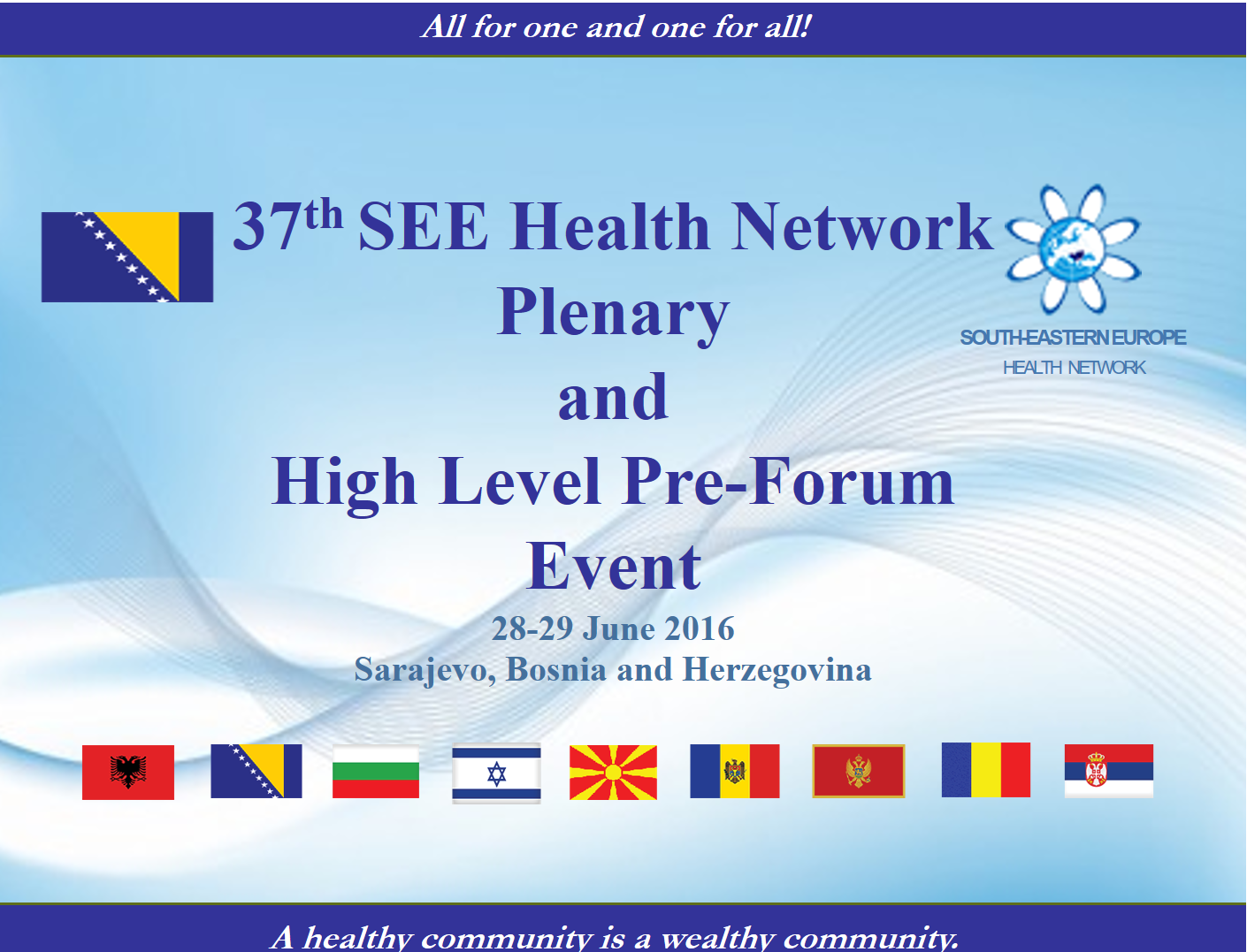
The 37th Plenary Meeting of the South-eastern Europe (SEE) Health Network was organized under the Presidency of Bosnia and Herzegovina (health authorities in B&H shall include the Ministry of Civil Affairs of Bosnia and Herzegovina, the Federal Ministry of Health, the Ministry of Health and Social Welfare of Republic of Srpska and the Department of Health and Other Services of Brcko District in Bosnia and Herzegovina) in the first half of 2016. It was held on 28–29 June 2016 in Sarajevo and was the first High Level Pre-Forum Event with senior government representatives from the SEEHN countries and their partners, organized jointly by the Presidency of Bosnia and Herzegovina and the SEEHN Secretariat.
n
The focus of the Fourth Forum and, respectfully, of the 37th Plenary Meeting of the SEEHN and High Level Pre-Forum Event in Sarajevo, Bosnia and Herzegovina was “Health, Wellbeing and Prosperity in South East Europe in the framework of the UN Sustainable Development Goals 2030”.
n
The 37th Plenary Meeting of the SEEHN and High Level Pre-Forum Event conducted the first round of inter-country consultations on five outcome and background political documents to be ready for Fourth SEE Health Ministerial Forum in Chisinau on 03-04 November 2016. The expected outcome of the 37thPlenary Meeting of the SEEHN and High Level Pre-Forum Event was to discuss and collect the opinions of all SEE governments on the extended sub-regional cooperation for introducing and/or strengthening the values, priority areas, and actions towards achieving better health, well-being and prosperity in the region in the framework of the UN Sustainable Development Goals (SDGs) 2030. A Memorandum of Understanding for partnership with Instituto Superiore di Sanità – URE (ISS), Rome, Italy initially was signed.
nSUMMARY REPORTnn Annex 1 – Pleanry ProgrammennAnnex 2 – List of ParticipantsnnAnnex 3 – Health Economic Footprint in South-eastern Europe: Economic and societal returns on investments in and for health Prof. Dragan GjorgjevnnAnnex 5 – SEE 2020 ImplementationnnAnnex 6 – Roadmap
News, News from the SEEHN Member States
|
Outcomes and Decisions
of the 37th Plenary Meeting of the South-eastern Europe Health Network (SEEHN) and High Level Pre-Forum Event
Sarajevo, Bosnia and Herzegovina, 28-29 June 2016
|
On 30 June 2016 the Presidency of Bosnia and Hercegovina of the SEE Health Network was completed with a full and unprecedented success, its peak being the 37th Plenary Meeting of the South-eastern Europe Health Network and High Level Pre-Forum Event “Health, Wellbeing and Prosperity in South East Europe in the framework of the UN Sustainable Development Goals 2030”, held on 28-29 JUne 2016 in Sarajevo.
This High Level Pre-Forum Meeting and 37th Plenary of the SEE Health Network is the most important event that will lead the SEE Governments and health professionals to a successful Fourth SEE Health Ministerial Forum in November 2016 in Chisinau, the Republic of Moldova.
The 37th Plenary Meeting of the South-eastern Europe Health Network and High Level Pre-Forum Event fulfilled its objective, e.g. conducted the first round of inter-country consultations on five important documents to be ready for the Ministers of Health at their forthcoming Fourth Ministerial Forum.
The 37th Plenary Meeting of the South-eastern Europe Health Network and High Level Pre-Forum Event confirmed the strong commitment of all SEE governments to the extended sub-regional cooperation for introducing and/or strengthening the values, priority areas, and actions towards achieving better health, well-being and prosperity in the region in the framework of the UN SDGs. In that respect, the first draft Chiasinau Pledge and the draft Framework towards developing the SEE Health Strategy 2030 in line with the UN Sustainable Development Goals 2030 were discussed and approved as an excellent starting point for the forthcoming multigovernmental consultation process in July – September 2016 prior to the Fourth Health Ministerial Forum.
Another strong decision of the 37th Plenary under the Presidency of Bosnia and Herzegovina was related to the revisions of the SEE Health Network Memorandum of Understanding (MoU) of 2008 and its Addendum of 2011, its STATUTES of 2004-2005, and the development of full-scaled standard operational procedures (SOPs). All countries´ high level representatives stood firm behind the commitment not only to extend the regional collaboration but to go towards developing a new Memorandum of Understanding of 2016 for the Ministers of Health to approve in Chisinau and, thereafter, to be endorsed by the SEE Health Network countries´ Governments and Parliaments, if required, so that the SEE Health Network becomes even stronger international organization with its own legacy and legal status.
Additionally, the participants of the 37th Plenary in Sarajevo approved with acclamations the two, so far developed, background documents that will serve as the evidence for the Ministers in Chisinau at their next Forum in November 2016. These are:
- draft study, to be published, on the regional collaboration for health and the SEE Health Network, and
- draft study on health, health systems and investments for health.
A third study on cross-border public health and SEE platform for emergencies is still in progress. These three studies and the forthcoming official publications will be serving as the solid evidence to back up the Chisinau Pledge, the Framework towards developing a SEE Health Strategy 2030 and the new SEEHN MoU with SOPs.
Last but not least:
- Memorandum of Understanding was signed with a new partner, Instituto Superiore di Sanità – URE (ISS), e.g. the National Institute of Public Health, Rome, Italy. The two partners will work together entirely in the area of emergency preparedness, response and management.
- A Decision on developing programs for reducing the excess salt intake in the countries of the region was also approved, based on a very successful multicounty workshop organized with the support of the EC TAIEX Instrument and held in Podgorica, Montenegro, April 2016.
The final report of the Presidency of Bosnia and Herzegovina and the Report of the 37th Plenary and High Level Pre-Forum Event will be posted by 20th July 2016 on the SEEHN Website.

News
n
n
The SEE Health Network Executive Committee and Secretariat are pleased to announce that on 03-04 November 2016 the SEE Health Network will convene the Fourth SEE Health Ministerial Forum in Chisinau, Republic of Moldova at the kind invitation of H.E. Ms. Ruxanda Glavan, Minister of Health, Republic of Moldova and Dr. Zsuzsanna Jakab, Regional Director, WHO Regional Office for Europe.
n
The Fourth Forum, entitled “Health, well-being and prosperity in South East Europe in the framework of the UN Sustainable Development Goals 2030”, will mark and celebrate the 15th Anniversary of the SEE Health Network since its onset and successful regional collaboration. Furthermore, it will strategically direct the future of the countries of the region, towards achieving improved health, well-being, prosperity and economic development.nIt is co-organized by the SEE Health Network, the Government of the Republic of Moldova, WHO Regional Office for Europe and the Regional Cooperation Council.
nn
n
News, News from the SEEHN Member States
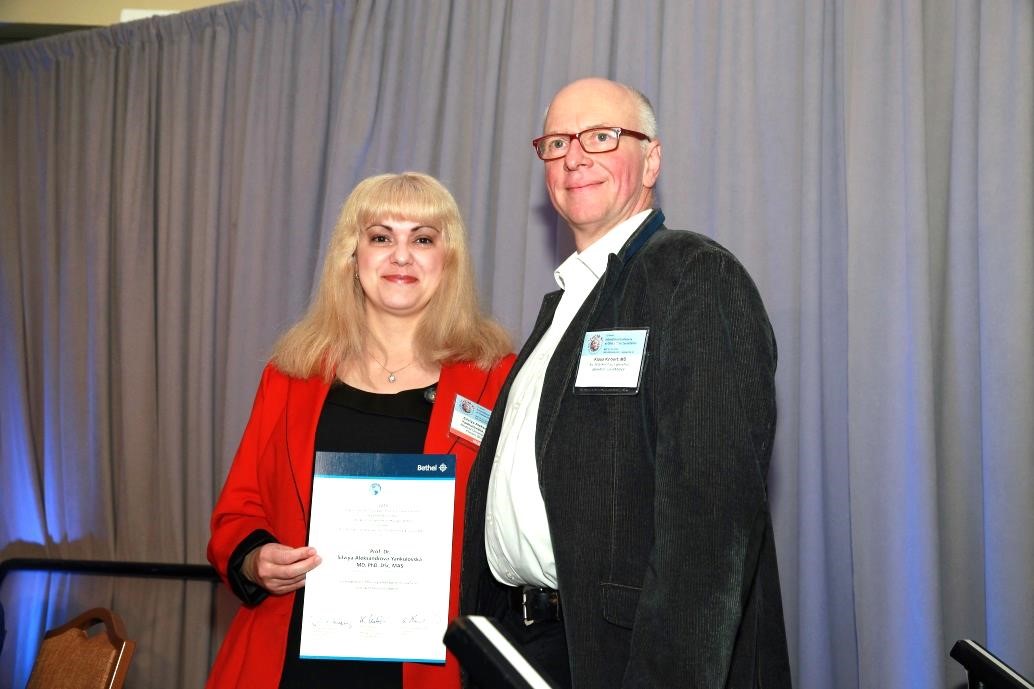
On 20-th of May at the opening ceremony of the 12-th International Conference on Clinical Ethics and Consultation the Hans-Joachim Schwager-Prize for Clinical Ethics for 2016 was presented to Prof. Silviya Aleksandrova-Yankulovska, Dean of the Faculty of Public Health at the Medical University of Pleven, Bulgaria.
The award carries the name of Professor Hans Joachim Schwager who was a pioneer in clinical ethics in Germany initiating ethics education for staff members and consultation rounds in early nineties in Bielefeld. The award aims at individuals or groups, who perform innovative or pioneer work in clinical ethics. As the implementation of a clinical ethics program often needs stamina and courage, the award is intended to encourage and support these initiatives.
The Board of Directors of the v. Bodelschwinghschen Stiftungen Bethel sponsor the Hans Joachim Schwager Award for Clinical Ethics and present the prize together with the International Conferences on Clinical Ethics and Consultation leadership. The Prize is presented to a scholar from Eastern Europe for first time which is a high recognition of Prof. Yankulovska’s work. She has been an active member of the European Clinical Ethics Network since its establishment closely studying European clinical ethics consultation practices and collaborating with all the leading European experts in the field.
The wining project is named “Application of adapted METAP methodology for clinical ethics consultation in Bulgaria” and took place in 6 clinical units in the country over the period May 2013 – December 2014. Applying the instruments of the methodology 69 ethics meetings with 286 participants were held altogether.
Professor Stella Reiter-Theil, President of  the Jury, in her laudation of Prof. Silviya Yankulovska underlined: “The winning project does not only consist of the adaptation of concepts and tools to the Bulgarian situation. It also provides, after only a few years of practice, already rich data and cases from various clinical sites in Bulgaria illustrating the value of applying the METAP methodology to engage clinical staff in ethical case discussions. After this fulminant start it can be expected that clinical ethics support will continue to raise interest and obtain acceptance in the Bulgarian health care sector. We wish the winner and her wining project all the best for the future!”
News, News from the SEEHN Member States
The Presidency of Bosnia and Herzegovina of the SEE Health Network (SEEHN) (health authorities in Bosnia and Herzegovina shall be understood as Ministry of Civil Affairs of Bosnia and Herzegovina, Federal Ministry of Health, Ministry of Health and Social Welfare of Republic of Srpska and Department of Health and Other Services of Brcko District of Bosnia and Herzegovina), its Executive Committee and Secretariat are pleased to make this advanced announcement of the 37th Plenary of the SEEHN and High Level Pre-forum Event.
The Event is called by H.E. Mr. Adil Osmanovic, President of the SEEHN, Minister of Civil Affairs of Bosnia and Herzegovina and will be held on 28-29 June 2016 in Sarajevo, Bosnia and Herzegovina.
The 37th Plenary of the SEEHN and High Level Pre-Forum Meeting is the most important event that will lead the SEE Governments and health professionals to a successful Fourth SEE Health Ministerial Forum in November 2016 in Chisinau, the Republic of Moldova. The Fourth Health Ministerial Forum is the next cornerstone of the regional cooperation for public health and well-being in South East Europe and it aims to further direct the political and technical collaboration that would benefit from a closer partnership between the SEE countries, members of this network.
The focus of the Fourth Forum and, respectfully, of the 37th Plenary Meeting of the SEEHN and High Level Pre-Forum Event in Sarajevo, Bosnia and Herzegovina is “Health, Wellbeing and Prosperity in South East Europe in the framework of the UN Sustainable Development Goals 2030”.
The Forum and the 37th Plenary of the SEEHN and High Level Pre-Forum Event come after 15 years of regional cooperation in SEE (2001-2016). The SEEHN will build on major European resolutions, charters and communications, treaties, frameworks and action plans. Included amongst these are the European policy framework for health, Health2020 and the SEE 2020 Strategy through which the SEEHN will continue to implement the values, priority areas and actions of these documents and will further implement joint sub-regional and national actions in the SEE region for achieving the UN Sustainable Development Goals 2030 (UN SDGs 2030) with the objective of better health, equity and accountability.
The 37th Plenary Meeting of the SEEHN and High Level Pre-Forum Event will conduct the first round of inter-country consultations on five outcome and background political documents to be ready for Fourth SEE Health Ministerial Forum in Chisinau on 03-04 November 2016. The expected outcome of the 37thPlenary Meeting of the SEEHN and High Level Pre-Forum Event will be to discuss and collect the opinions of all SEE governments on the extended sub-regional cooperation for introducing and/or strengthening the values, priority areas, and actions towards achieving better health, well-being and prosperity in the region in the framework of the UN Sustainable Development Goals (SDGs) 2030. It is also expected that a Memorandum of Understanding for partnership with Instituto Superiore di Sanità – URE (ISS), Rome, Italy will be signed.
News
DOWNLOAD CALL NOTICE HEREnnDOWNLOAD YOUNG FORUM GASTEIN NETWORK BROCHUREn
YOUNG FORUM GASTEINn27 September – 1 October 2016, Bad Hofgastein, AustriannCall for applications, Newcomers Scholarship 2016
n
The Young Forum Gastein Scholarship was initiated in 2007 by the International Forum Gastein (IFG), with the support of the European Commission. The scholarships enable young health professionals to attend the EHFG conference to learn about the latest health developments in Europe and meet and debate with European and global health experts. A limited number of scholarships (covering registration fee, travel and accommodation expenses) are available for applicants fulfilling the requirements described below.
n
Requirements:
nn
n
- Citizenship of one of the 28 EU member states or candidate countries or EFTA countries (Iceland, Liechtenstein, Norway and Switzerland);
n
- Age limit of 35 years or under on 27 September 2016;
n
- Proficiency in English (oral and written);
n
- Hold a Masters degree in a health related subject;
n
- Relevant work experience of at least 2 years (full time) in the field of health/public health (policy or research);
n
- Proof of current work in the field of public health (for a university or national research institute, a government ministry or for a non-governmental organisation – or if your employer will cover your costs, for a private company);
n
- For 2016 a limited number of places are also available for young professionals working in a health role in industry, however scholarships to cover the costs of participating must in this case be borne by the employer at the time of your application.
n
n
By applying for the Young Forum Gastein scholarship the applicant confirms his/her availability to undertake an active role before and during the conference. This is a pre-condition for being accepted as a scholar. Available tasks may include participation in presentations, panel discussions, reporting on the event,contributing to the conference web-blog, conducting interviews, tweeting, writing news articles etc. Please note that the Young Forum Gastein programme at the EHFG 2016 commences one day before the official start of the EHFG conference, on Tuesday 27 September. Activities will take place up to and including the evening of Friday 30 September, with travel home on Saturday 1 October.
n
To apply, please fill out then– Newcomer – YFG Personal Details Form by clicking here andn– submit the following documents in English:
n
1) CV: Please submit a full Curriculum Vitae;n2) English Proficiency: Please submit proof of very good command of oral and written English (i.e. a formal certificate/qualification demonstrating proficiency in English OR proof of publications or other written work in English OR employer confirmation of your English ability and regular use of English in your day to day work);n3) Passport Scan/Copy: Please submit a photocopy of your passport or identity card for proof of your nationality and age (age limit of 35 years of age or under on 27 September 2016).n4) Letter of Support: Please submit a brief letter from your manager on your organisation´s headed paper confirming that:na) You are working in the field of public health and have at least 2 years full time work experience in this field;nb) Your manager supports your application and if you are selected as a Young Forum Gastein scholar in 2016 your organisation will grant you leave to participate in the Young Gastein programme and attend the EHFG from Tuesday 27 September to Saturday 1 October 2016. (For information and planning purposes, Young Forum Gastein starts on Tuesday 27 September 2016, one day before the EHFG officially commences, and depending on flight availability some participants may need to arrive on Monday 26 September).nc) If you are applying from industry, please also include in this letter confirmation that your employer has agreed to cover your costs if you are selected (approximately 1,800 Euros).
n
Only full applications will be considered. Scholars will be selected based on the merit of their applications andnto ensure a balanced participation from countries, representatives of science, public administration, civil societynand industry, and a suitable mix of Young Forum Gastein alumni and newcomers. We will inform applicants ofnthe outcome as soon as we can, usually by the end of June.
n
Please fill out the YFG Personal Details Form and send Josef Wenninger Josef(at)ehfg.org the above documents in electronic format by midnight on Monday 16 May 2016.
n

News
n
n
n
n
| Vacancy Notice No: 1nnTitle: Administrative Assistantnn |
n
Date: 06 April, 2016nnApplication Deadline: 13 April 2016nnDuty Station: SEEHN Secretariat, Skopje Republic of Macedonia |
n
n
n
nPurpose of the post: The SEEHN secretariat is an institution of the Network that provides technical, managerial and administrative support to the activities of the Network. Under general supervision of the Head of the Secretariat and the direct supervision of the Finance Officer, the incumbent of the post is responsible for the efficient management of the administrative and operational functions involved in the day-to-day running of the Secretariat of SEEHN and the optimal utilization of financial and human resources.nn Objectives of the post:n
n
- To ensure efficient and continuous administration and operation of the SEEHN secretariat.
n
nImplement the SEEHN operational plans agreed at the plenary meetings of the network, within a road map of activities.n
n
- Ensure timely reporting to the Network and the Executive Committee on program implementation activities.
n
nDescription of duties:nProvide support to the SEEHN staff for the management and control of all administrative services and operations. Such services and operations include, procurement, human resources conference, workshops and events management, and office space and equipment arrangements;nReception duties:n
n
- Answer telephone calls, send, receive and file faxes and office mail
n
- Provide information in response to visitor or telephone inquiries
n
- Call the appropriate office to obtain information on specialized and technical questions
n
- Direct authorized visitors to the proper offices, verify and arrange appointments
n
- Preparing/organizing the office for scheduled group meetings.
n
nFile Management:n
n
- Receive and send project mail
n
- Maintain employee contact files
n
- Photocopy materials as required
n
- Assist in office supply procurement.
n
- Perform written translation of various materials, including incoming and outgoing mail;
n
- Assist with logistics for Activities, seminars and other events (request offers from vendors, lodging and travel arrangements, rental equipment, interpreters etc. in coordination with the respective member states staff);
n
- Arrange travel for employees and transportation and accommodation for visitors and consultants;
n
nMeeting Administrationn
n
- Arrange, coordinate and lead administrative preparation for meetings, seminars, workshops, including letters of invitation, costs
n
- calculation and travel requests; assisting with preparation of documents, dispatching of materials and liaising with participants and
n
- others involved.
n
- Prepare presentations using PowerPoint and other software packages on own initiative or on the basis of instructions.
n
- Schedule weekly team and ad hoc meetings, according to schedules and need; taking and preparation of minutes.
n
- Obtain briefing and background materials for meetings, seminars, workshops, etc. to be attended by the team’s professional
n
- staff, checking their availability and ensuring they have the appropriate briefing files and documents.
n
nEducation: nnEssential: University degree in public or business administration, finance or a related field. Desirable: Qualifications in management and/or administration, experience in WHO activity, or in other international organizations.nnFunctional Skills and Knowledge: n
n
- Essential: Sound knowledge of office management, administration, human resources, finance/accounting and budget.
n
- Excellent spreadsheet and writing skills with Microsoft Office TM Word, Excel, PowerPoint, Office, Internet applications and strong communication skills are required.
n
- Desirable: Specialized knowledge of international organizations administrative rules, procedures and practices is an asset.
n
nLanguages: n
n
- Essential: Fluent knowledge of English (both written and verbal);
n
- Desirable: Good knowledge of the languages of the 10 SEEHN countries and other European languages
n
nExperience: n
n
- Essential: At least 1 year of experience preferably at international level in office management and general administration.
n
n The position will be a short-term, three to six months with a possibility of extension. All details such is duration of the contract and remuneration will be discussed with the most successful/qualified candidate.nnCandidates are invited to submit their candidacy letter accompanied by their CV and any other proves of their skills and competences to the SEEHN Secretariat to Maria Ruseva at rusevamaria33@gmail.com and Natasha Lazovska at natasha@on.net.mknn nn
News
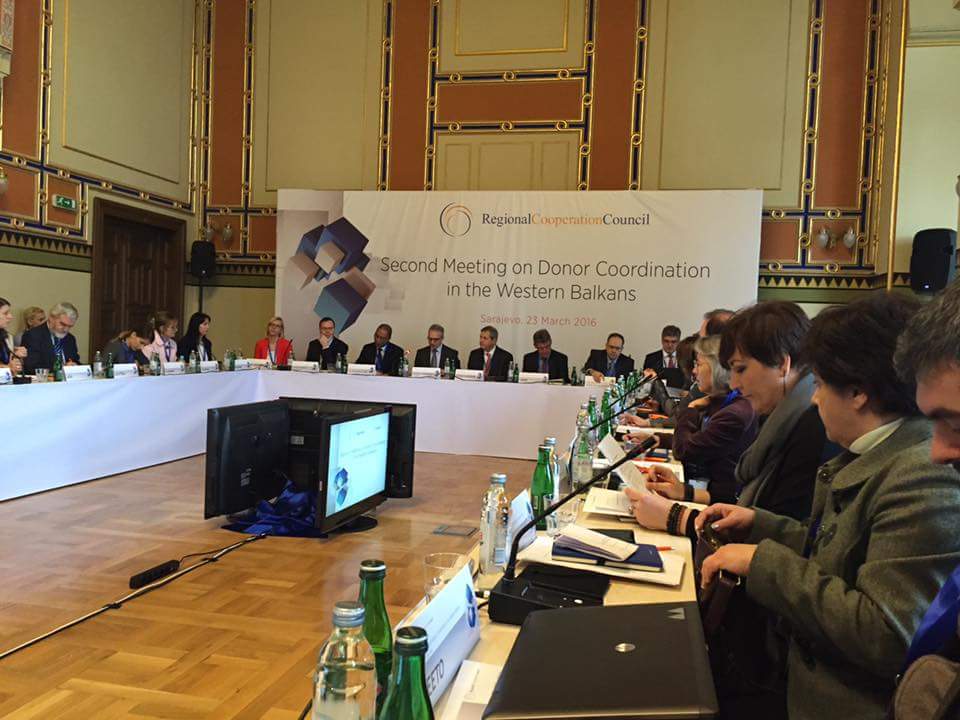
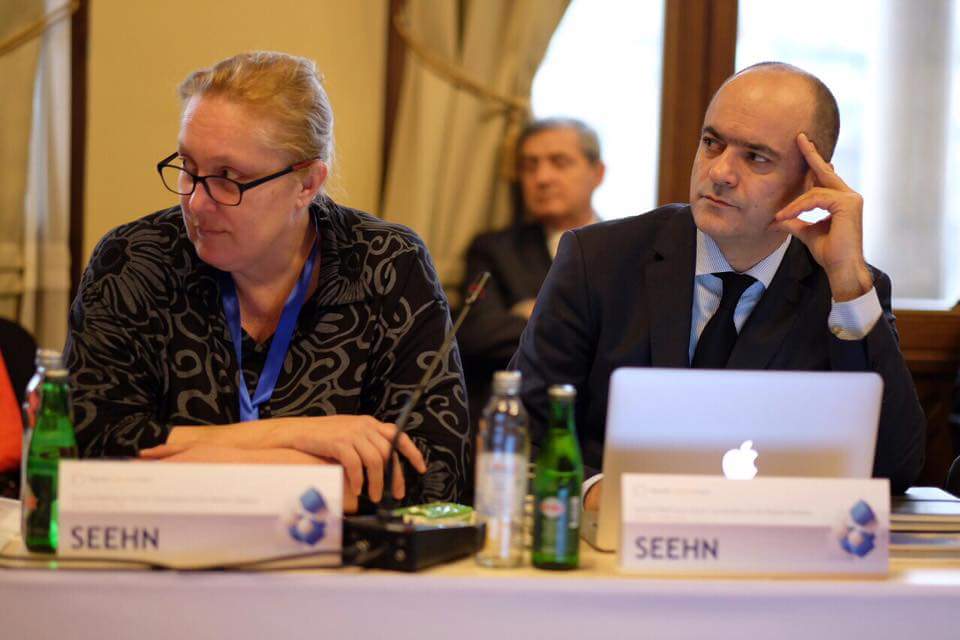
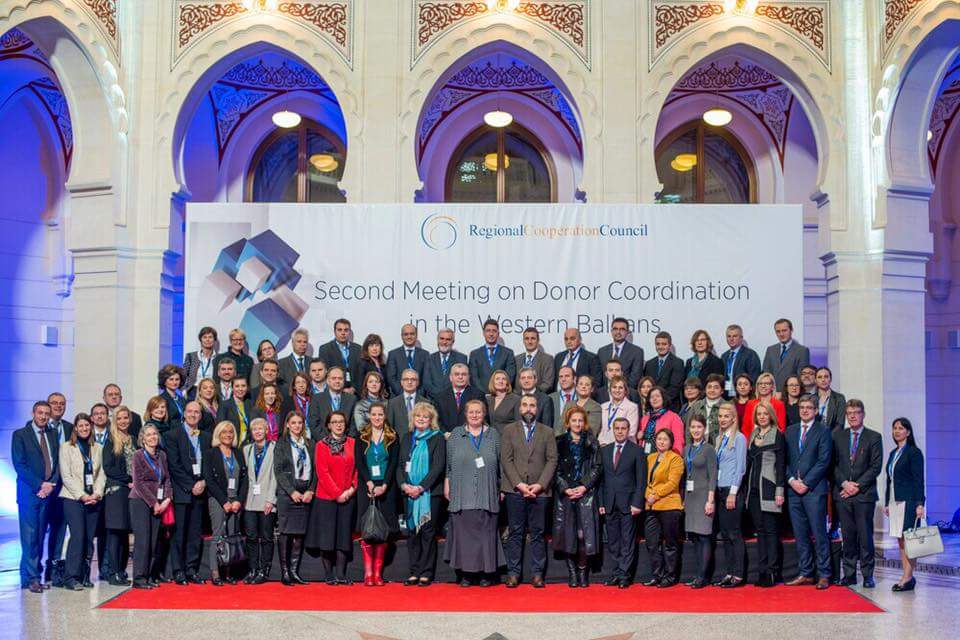
On 23 March the SEE Health Network participated at the Regional Cooperation Council (RCC) Second Donors Conference held in Sarajevo, Bosnia and Herzegovina. It was represented by its current Presidency of Bosnia and Herzegovina (BIH) by its two leading Bosnian representatives, the National Health Coordinators (NHC) Dr. Amela Lolic and Dr. Goran Cerkez.
n
The RCC Second Donors Conference discussed various important issues related to the implementation of the SEE 2020 Strategy “Jobs and Prosperity in a European Perspective” endorsed in October 2013. For the first time in the history of the region and beyond health has found its appropriate place and visibility in the “Inclusive Growth” Pillar with four health objectives and respective measures.
n
During the Confer ence plenary sessions the SEEHN Senior Representatives pointed out that:
nn
n
- The network has both its political and technical dimensions and mechanisms responsible for implementing regional health actions of common interest often called as “multisectorial project”, such as health and tourism, health and education, E-health or health and security;
n
- The region and Europe live in time of terrorism, threats and bioterrorism in that context;
n
- Health has an important role to play in implementing the SEE 2020 Strategy particularly in the time of the global and European refugee crisis with the movement of thousands of migrants to the EU; health has an important role;
n
n
The SEE ministries of health do work in line with the SEE Growth Strategy 2020 as well as for achieving the goals of the WHO European health policy framework 2020 and the EU “Health in All Policies” approach.
n
The SEEHN Senior Representatives highlighted that by reducing the funding for health care and public health actions the region reduces funding for development, prosperity and progress as health is a contributor for health, wealth, well-being and prosperity rather than only a consumer, which is usually the general understanding. A sick person consumes significant resources and often mobilizes the public, family and social services.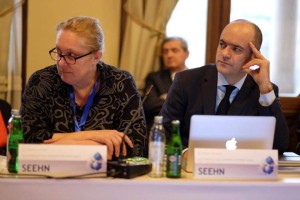
n
For all above reasons, the SEEHN Senior Representatives and the Bosnian Presidency appealed to the RCC and the donors present in Sarajevo to support several important health and public health areas that are already part of the SEE 2020 Strategy as follows:
nn
n
- Cross-border Public Health and Emergencies preparedness including communicable diseases surveillance and control, antimicrobial resistance, emergencies and joint actions to mitigate natural disasters, man-made disasters as well as the issue of the huge influx of migrants to the SEE region;
n
n
n
- Strengthening the health systems and public health capacities to fight the epidemics of noncommunicable diseases and mental health disorders in the region (including improving quality of health services and introducing high technologies such as transplantations and improved donor collection and exchanges as started already) that are the main factor contributing to improving health and well-being and, thus, contributing to better productivity of the human/labor capacities in the region;
n
n
n
 Working on the health workforce outstanding issues and their mobility as the health sector is one of the biggest “employers” of the region with close to 10% of its workforce.
n

News
The South Eastern European Journal of Public Health (SEEJPH) published the “Ten years onwards: Comparison of the South Eastern European regional public health strategy 2004 and the South Eastern European 2020 strategy” article, written by Christiane Wiskow, Maria Ruseva and Ulrich Laaser, which strives to show the ongoing regional collaboration that has continuously contributing to the development of the public health in the South Eastern Europe (SEE) region since 2000 when the public health collaboration in SEE (PH-SEE) was initiated.nnThis article gives an overview of the two frameworks for regional collaboration in the area of public health, such is the framework developed in 2004 by a network of public health professionals and academics, and another one developed by the SEE Health Network as an integral part of the SEE 2020 strategy, both with reviewed situation analysis using the SWOT methodology.nnThe comparison is made regardless the differences in structure and wording, showing that both strategies are consistent in the majority of their goals and actions which includes improving equity in health with a focus on vulnerable and low-income groups, hence improving health for all, strengthening human resources for health and public health, respectively and strengthening and improving intersectoral cooperation and governance. In addition to the commonalities, there are also apparent differences between the two strategies in the aspects of social participation, regional public health information, the cross-border public health and the quality improvement.nnNevertheless, despite the time lag of nearly ten years, the commonalities of the strategies for regional public health collaboration are very significant and the differences between them are partially due to the different development context. The authors of this article are giving conclusion that the collaboration between the two networks, FPH-SEE and SEEHN particularly in the area of public health education, could be of mutual benefit and will contribute in further strengthening for the improvement of regional health information.nn nnOn the link below you can read the full article published on the SEEJPHnnTen years onwards: Comparison of the South Eastern European regional public health strategy 2004 and the South Eastern European 2020 strategy
News
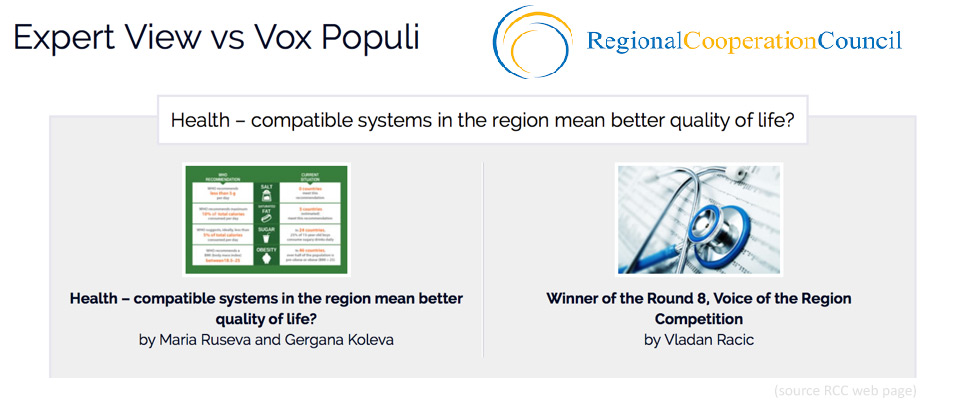
In April 2015, in the effort to increase public engagement in policy making, the Regional Cooperation Council (RCC) announced a competition “Voice of the Region”, inviting citizens to take part and give their views through essay, video or photography on issues they face in everyday life. The competition was organized in 8 rounds on different topics, enriching the debate with an invited expert view on each of them.nnAs part of the long-term fruitful cooperation with SEEHN and the importance of recognizing health and well-being as contributor to the economic growth, one theme was dedicated to health, debating on whether compatible systems in the region mean better quality of life. Giving the opportunity for everyone to write articles and be part of the competition RCC opens doors for people to inform themselves and do some health research.nnDr Maria Ruseva, an international expert on public health and health systems together with Gergana Koleva an international public health consultant had written their expert view underlining the need of involving the non-health sectors and industries in the process of achieving the goal of every country which is ensuring a better quality of life for its citizens. They say this is necessary because of the explicit risks to health certain services and products carry – risks which often materialize as diseases and impose a health and economic burden on individuals and societies only years later when damages are harder to reverse than to have had prevented in the first place. Very important point of view is recognizing the need of investing in health which contributes to sustainable growth at the same time as it limits societal exposure to health risks through appropriate policies and actions. This is the reason why in Bulgaria, the Ministry of Health recently announced a plan to introduce a tax on foods with salt and sugar content above the allowed levels. The proposal follows similar public health taxes launched in Hungary in 2011 (known as the “chips tax”) and in Finland the same year (known as the “sweet tax”). It aims to signal to food manufacturers to shift to healthier product alternatives or face declining demand, and at the same time serves as a behavioral nudge to consumers to encourage better eating habits.nn nnVladan Racic’s essay “Nothing but health…” was chosen as winner of the round 8 of the Voice of the Region Competition. His winning arguments emphasize that neither money, education or power would matter without health, and thus prevention is very important: “There is an old adage “value your health now before it’s too late””. Being the voice of the region for health, Vladan wrote that it is necessary that those in power realize that health is the most important factor of a society.nn nnOn the links below you can read:n

News
Under the current SEEHN presidency of the Ministry of Health of Albania, the Minister of Health of the Republic of Albania and current President of the Network Mr. Ilir Beqaj, organized a high-level Meeting and the 36th Plenary of the South-eastern Europe Health Network on December 10-11, 2015 in Tirana, Albania. Following up on the previous two Ministerial meetings held in Skopje and Belgrade, it brought into focus the topic of “Strengthening health systems for universal health coverage towards improved health and wellbeing”.nnThrough open and lively discussion, the senior representatives focused on Universal Health Coverage (UHC), the state of art in each one of the SEE countries, their challenges, actions and the potential for joint regional activities in 2016 and onwards. A number of common challenges were identified that pose barriers to achieving the goals of UHC, for example, insufficient monitoring and evaluation capacities and inadequate health workforce. The High Level Meeting requested extended technical support from WHO Regional Office for Europe which will involve both UHC and people-centred integrated health services delivery.nnThe major humanitarian crisis and the emerging health risks that Europe and the SEE region are facing due to the displacement and migration of populations across the Region, caused by natural and manmade disasters, require both stronger sub-regional presence in the regional discussions on health and other health-related issues that might affect the health systems and economies of the SEEHN Member States in the coming decades, and well-informed and well-implemented government policies.nnWith this in view, the meeting provided the high level representatives of SEEHN member states with the opportunity to share their own national challenges, needs and ideas for potential regional actions in the framework of the Network and the SEE Regional Cooperation Process and to agree on joint regional and national actions for securing universal health coverage in the context of migration and health and health security needs and challenges, thus reaffirming their political commitment to the sub-regional collaboration in the SEE.nnFinally, the intensive regional collaboration, its discussions and several important decisions paved the way towards further increasing the efficacy of the SEEHN in 2016, the next Fourth SEE Ministerial Forum in 2016 to be held in Chisinau under the auspices of the Government of the Republic of Moldova.nn

News
As part of the Albanian presidency of SEEHN (South East European Health Network), a two day workshop was held in Tirana, Albania, entitled Improving data for policy. Members of the Network, which includes representatives from Albania, Bosnia and Herzegovina, Bulgaria, Croatia, Israel, Montenegro, the Republic of Moldova, Romania, Serbia and the former Yugoslav Republic of Macedonia, sent senior health information experts, leaders and decision-makers to participate. Principal topics were strengthening health information systems and also vital registration systems, recording essential information such as births and deaths.nnShared goals and shared challengesnnAs well as providing a forum for networking and exchanging ideas, the workshop was an opportunity to discuss models of health information networks operating in the European Region and also to enable partner countries to discuss such models for the SEEHN community, identify common ground and challenges that could be addressed collectively.nnAt the workshop, participants were unanimous in their recommendation that SEEHN countries should establish a health information network – a clear recognition of the importance of health information in establishing an evidence base for decision making in health policy. WHO will be organizing a workshop next year where countries will agree on the modus operandi and terms of reference of such a network.nn nnLinksn
n nnLocations for postingn
n nnPhoto gallerynn
News
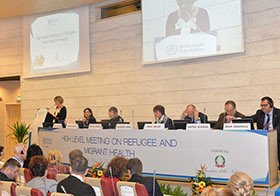
On 23-24 November 2015 in Rome, Italy, upon request at the 65th session of the WHO Regional Committee for Europe this September, the Italian Government and its Ministry of Health hosted a WHO High-level meeting on refugee and migrant health.nnThe attending Ministers and senior representatives of Member States of the WHO European Region discussed about the numerous public health challenges posed by large-scale movements of refugees and migrants to transit and destination countries. Ms Beatrice Lorenzin, Minister of Health of Italy, opened the meeting with a short statement conveying His Holiness Pope Francis’ welcoming to the Conference and calling on Ministers to bring wisdom, strength and peace to the discussions. She also, paid tribute to the health workers who are stepping up for the challenges of the health service regarding the constantly increasing numbers of refugees and migrants arriving at Italy’s boarders. Representatives of the Office of the United Nations High Commissioner for Refugees, the United Nations Children’s Fund, the European Commission, the European Centre for Disease Prevention and Control and the International Organization for Migration also took part and attended this meeting.nnThis high-level meeting provided an opportunity for defying the main public health and health system challenges that the host countries are facing such as, preparedness for immediate response and efficient acceptance of large groups that are complex, resource-intensive and potentially socially disruptive.nnDr Zsuzsanna Jakab, WHO Regional Director for Europe, highlighted that this is not a new phenomenon but the scale of migration is and the ageing population and migration are the two demographic factors that will shape the health challenges of the European Region in the 21st century. She explained that the meeting is for the public health aspects of migration – not the political or security aspects. As a WHO Regional Director for Europe, Dr Jakab stated that we as a Region must seek to ensure that all countries are adequately prepared and organized to withstand the added pressures of supporting a mass influx of people, while at the same time protecting the health of their resident populations.nnIn her concluding comments, Dr Jakab reaffirmed: “As the European public health community, we must do what we can to respond to the needs of those fleeing, to see that they are cared for in both the short and longer terms, and that our health systems are able to deal effectively and humanely with these extra demands, whilst continuing to offer full services to resident populations. We have the tools and knowledge to succeed.”nnDr Santino Severoni, Coordinator of the Public Health Aspects of Migration in Europe (PHAME) project at WHO Regional Office for Europe, addressed the changing face of migration into the European Region and the focus areas of the PHAME project. He said that the goals of the PHAME project are to reduce excess mortality and morbidity, minimize the negative impacts of migration, avoid disparities in health status and access and ensure the rights of refugees and migrants to health care.nn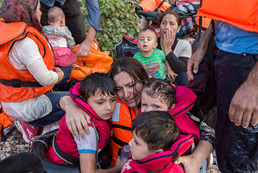 In addition, the panel discussion on the public health aspects of migration defining the challenges presented by communicable and non-communicable diseases. Panellists placed the focus on health care, social services and education which must coordinate to provide effective support, particularly to the most vulnerable. They emphasized the commitment to provide universal access to health services, including services on arrival or on transit routes that are typically provided by NGOs. Dr Nedret Emiroglu, Director of the Division of Communicable Diseases and Health Security at WHO/Europe noted that refugees are more vulnerable on diseases than local population.nnClosing the meeting, Dr Zsuzsanna Jakab thanked the Government of Italy for hosting the event and noted that the Regional Office can support Member States in coordinating efforts and working on many of the tasks identified during the meeting.nnThe migration and health will also be one of the main topics of the 36th Plenary Meeting of the South-eastern Europe Health Network (SEEHN) that will take place in Tirana on December 10th, 2015.nnLinks:n