News
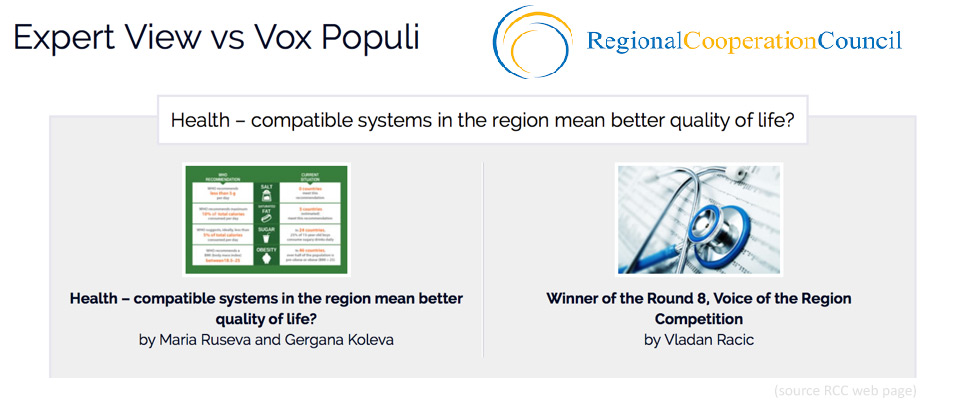
In April 2015, in the effort to increase public engagement in policy making, the Regional Cooperation Council (RCC) announced a competition “Voice of the Region”, inviting citizens to take part and give their views through essay, video or photography on issues they face in everyday life. The competition was organized in 8 rounds on different topics, enriching the debate with an invited expert view on each of them.nnAs part of the long-term fruitful cooperation with SEEHN and the importance of recognizing health and well-being as contributor to the economic growth, one theme was dedicated to health, debating on whether compatible systems in the region mean better quality of life. Giving the opportunity for everyone to write articles and be part of the competition RCC opens doors for people to inform themselves and do some health research.nnDr Maria Ruseva, an international expert on public health and health systems together with Gergana Koleva an international public health consultant had written their expert view underlining the need of involving the non-health sectors and industries in the process of achieving the goal of every country which is ensuring a better quality of life for its citizens. They say this is necessary because of the explicit risks to health certain services and products carry – risks which often materialize as diseases and impose a health and economic burden on individuals and societies only years later when damages are harder to reverse than to have had prevented in the first place. Very important point of view is recognizing the need of investing in health which contributes to sustainable growth at the same time as it limits societal exposure to health risks through appropriate policies and actions. This is the reason why in Bulgaria, the Ministry of Health recently announced a plan to introduce a tax on foods with salt and sugar content above the allowed levels. The proposal follows similar public health taxes launched in Hungary in 2011 (known as the “chips tax”) and in Finland the same year (known as the “sweet tax”). It aims to signal to food manufacturers to shift to healthier product alternatives or face declining demand, and at the same time serves as a behavioral nudge to consumers to encourage better eating habits.nn nnVladan Racic’s essay “Nothing but health…” was chosen as winner of the round 8 of the Voice of the Region Competition. His winning arguments emphasize that neither money, education or power would matter without health, and thus prevention is very important: “There is an old adage “value your health now before it’s too late””. Being the voice of the region for health, Vladan wrote that it is necessary that those in power realize that health is the most important factor of a society.nn nnOn the links below you can read:n

News
Under the current SEEHN presidency of the Ministry of Health of Albania, the Minister of Health of the Republic of Albania and current President of the Network Mr. Ilir Beqaj, organized a high-level Meeting and the 36th Plenary of the South-eastern Europe Health Network on December 10-11, 2015 in Tirana, Albania. Following up on the previous two Ministerial meetings held in Skopje and Belgrade, it brought into focus the topic of “Strengthening health systems for universal health coverage towards improved health and wellbeing”.nnThrough open and lively discussion, the senior representatives focused on Universal Health Coverage (UHC), the state of art in each one of the SEE countries, their challenges, actions and the potential for joint regional activities in 2016 and onwards. A number of common challenges were identified that pose barriers to achieving the goals of UHC, for example, insufficient monitoring and evaluation capacities and inadequate health workforce. The High Level Meeting requested extended technical support from WHO Regional Office for Europe which will involve both UHC and people-centred integrated health services delivery.nnThe major humanitarian crisis and the emerging health risks that Europe and the SEE region are facing due to the displacement and migration of populations across the Region, caused by natural and manmade disasters, require both stronger sub-regional presence in the regional discussions on health and other health-related issues that might affect the health systems and economies of the SEEHN Member States in the coming decades, and well-informed and well-implemented government policies.nnWith this in view, the meeting provided the high level representatives of SEEHN member states with the opportunity to share their own national challenges, needs and ideas for potential regional actions in the framework of the Network and the SEE Regional Cooperation Process and to agree on joint regional and national actions for securing universal health coverage in the context of migration and health and health security needs and challenges, thus reaffirming their political commitment to the sub-regional collaboration in the SEE.nnFinally, the intensive regional collaboration, its discussions and several important decisions paved the way towards further increasing the efficacy of the SEEHN in 2016, the next Fourth SEE Ministerial Forum in 2016 to be held in Chisinau under the auspices of the Government of the Republic of Moldova.nn

News
As part of the Albanian presidency of SEEHN (South East European Health Network), a two day workshop was held in Tirana, Albania, entitled Improving data for policy. Members of the Network, which includes representatives from Albania, Bosnia and Herzegovina, Bulgaria, Croatia, Israel, Montenegro, the Republic of Moldova, Romania, Serbia and the former Yugoslav Republic of Macedonia, sent senior health information experts, leaders and decision-makers to participate. Principal topics were strengthening health information systems and also vital registration systems, recording essential information such as births and deaths.nnShared goals and shared challengesnnAs well as providing a forum for networking and exchanging ideas, the workshop was an opportunity to discuss models of health information networks operating in the European Region and also to enable partner countries to discuss such models for the SEEHN community, identify common ground and challenges that could be addressed collectively.nnAt the workshop, participants were unanimous in their recommendation that SEEHN countries should establish a health information network – a clear recognition of the importance of health information in establishing an evidence base for decision making in health policy. WHO will be organizing a workshop next year where countries will agree on the modus operandi and terms of reference of such a network.nn nnLinksn
n nnLocations for postingn
n nnPhoto gallerynn


