News
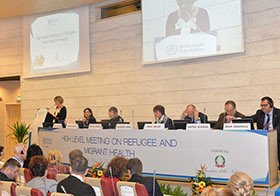
On 23-24 November 2015 in Rome, Italy, upon request at the 65th session of the WHO Regional Committee for Europe this September, the Italian Government and its Ministry of Health hosted a WHO High-level meeting on refugee and migrant health.nnThe attending Ministers and senior representatives of Member States of the WHO European Region discussed about the numerous public health challenges posed by large-scale movements of refugees and migrants to transit and destination countries. Ms Beatrice Lorenzin, Minister of Health of Italy, opened the meeting with a short statement conveying His Holiness Pope Francis’ welcoming to the Conference and calling on Ministers to bring wisdom, strength and peace to the discussions. She also, paid tribute to the health workers who are stepping up for the challenges of the health service regarding the constantly increasing numbers of refugees and migrants arriving at Italy’s boarders. Representatives of the Office of the United Nations High Commissioner for Refugees, the United Nations Children’s Fund, the European Commission, the European Centre for Disease Prevention and Control and the International Organization for Migration also took part and attended this meeting.nnThis high-level meeting provided an opportunity for defying the main public health and health system challenges that the host countries are facing such as, preparedness for immediate response and efficient acceptance of large groups that are complex, resource-intensive and potentially socially disruptive.nnDr Zsuzsanna Jakab, WHO Regional Director for Europe, highlighted that this is not a new phenomenon but the scale of migration is and the ageing population and migration are the two demographic factors that will shape the health challenges of the European Region in the 21st century. She explained that the meeting is for the public health aspects of migration – not the political or security aspects. As a WHO Regional Director for Europe, Dr Jakab stated that we as a Region must seek to ensure that all countries are adequately prepared and organized to withstand the added pressures of supporting a mass influx of people, while at the same time protecting the health of their resident populations.nnIn her concluding comments, Dr Jakab reaffirmed: “As the European public health community, we must do what we can to respond to the needs of those fleeing, to see that they are cared for in both the short and longer terms, and that our health systems are able to deal effectively and humanely with these extra demands, whilst continuing to offer full services to resident populations. We have the tools and knowledge to succeed.”nnDr Santino Severoni, Coordinator of the Public Health Aspects of Migration in Europe (PHAME) project at WHO Regional Office for Europe, addressed the changing face of migration into the European Region and the focus areas of the PHAME project. He said that the goals of the PHAME project are to reduce excess mortality and morbidity, minimize the negative impacts of migration, avoid disparities in health status and access and ensure the rights of refugees and migrants to health care.nn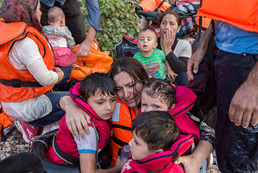 In addition, the panel discussion on the public health aspects of migration defining the challenges presented by communicable and non-communicable diseases. Panellists placed the focus on health care, social services and education which must coordinate to provide effective support, particularly to the most vulnerable. They emphasized the commitment to provide universal access to health services, including services on arrival or on transit routes that are typically provided by NGOs. Dr Nedret Emiroglu, Director of the Division of Communicable Diseases and Health Security at WHO/Europe noted that refugees are more vulnerable on diseases than local population.nnClosing the meeting, Dr Zsuzsanna Jakab thanked the Government of Italy for hosting the event and noted that the Regional Office can support Member States in coordinating efforts and working on many of the tasks identified during the meeting.nnThe migration and health will also be one of the main topics of the 36th Plenary Meeting of the South-eastern Europe Health Network (SEEHN) that will take place in Tirana on December 10th, 2015.nnLinks:n

News
Preparing health professionals to meet the expanding health and social needs of ageing societies while enabling them to pursue rewarding career paths in their country of origin is a rising priority for governments in South-eastern Europe, whose health sectors have been weakened in recent years by external and internal migration. To discuss strategies for strengthening the technical capacity of the region’s health workforce through transformative education and solutions to the geographic imbalance, a high-level meeting organised by WHO Regional Office for Europe in collaboration with the South-eastern European Health Network (SEEHN) and hosted kindly by the Medical University of Varna, Bulgaria, took place on 9-10 November in Varna.
Attended by representatives of health and education ministries, national public health institutions, and universities from Albania, Bosnia and Herzegovina, Bulgaria, Croatia, and the Republic of Moldova, and by WHO experts, the meeting outlined the need for improved alignment between health workforce education and training curricula on the one hand and evolving professional competencies required by new models of health care and changing public health needs on the other. Participants discussed solutions to existing barriers to cooperation between the health and education sectors and highlighted the need to establish a systematic process for health workforce planning with shared responsibility between ministries of health, employment and finance.
Other priorities emphasised in the course of the meeting included the need to shift towards evidence-based professional education and to retain faculty who can deliver it, to secure political support for enhanced teaching and training modalities, and to increase intersectoral cooperation by initiating policy dialogues on planned curriculum reforms with all stakeholders.
The vision of transformative education includes development of competencies and skills – both through basic health workforce education and through continuing professional development – that are linked to nationally and contextually relevant needs, as well as to global standards of excellence. Such education aims to maximise the contributions of all health workers.
Translating this vision into practice is essential to implementing Health 2020, the European policy framework for improving the health of populations and reducing health inequities, in which health professionals play a central role. It is also essential to implementing the SEE 2020 Strategy “Jobs and prosperity in an European Perspective”. To operationalize this vision, countries need strengthened sub-regional collaboration, continued technical support and cooperation, and greater alignment between educational institutions and the systems that are responsible for health service delivery.
The meeting in Bulgaria followed the WHO Regional expert consultations on transformative health professionals’ education and training in support of Health 2020 and a series of sub-regional technical meetings on health workforce mobility and retention in 2013 in the Republic of Moldova and in 2014 in Slovenia , which drew commitment by members of SEEHN to build a sustainable health workforce responsive to the current and future health needs of their populations.
News, News from the SEEHN Member States
The Jubilee Scientific Conference celebrating the 10th anniversary of the Faculty of Public Health in Pleven took place on 1-3 October 2015 under the title of “Public Health Policy and Practice”.
Divided into three plenary sessions, various conference topics were tackled in the context of both the negative public health trends that Bulgaria faces and the urgency to find appropriate solutions. Bringing into focus the epidemiology of infectious and chronic non-infectious diseases, the ethics of public health and clinical practice as well as health promotion and management, quality of health care and medical rehabilitation and ergotherapy, the Jubilee Conference has provided health professionals and managers with the opportunity to exchange valuable experience and ideas and to enhance their professional connections in the field of public health research and practice for prevention and control of public health processes.
The abstracts of the Jubilee Scientific Conference comprise the latest edition of the Journal of Biomedical and Clinical Research, issued by the Medical University – Pleven twice per year. Entirely dedicated to conference itself, this edition also features the Rector of the Medical University Prof. Dr. Slavcho Tomov who describes the Faculty of Public Health as the “leading structure within our university and a solid educational center for training of public health professionals and managers”.


